-
The Need for Speed
I’ve read, written, and thought about the Royal Mail Steamer Titanic for nigh on 35 years now. And Monday evening, I had a thought which I’d never thought, written, or read before.
If you were to physically apprehend a modern English-speaking human and ask her “Why did the Titanic hit the iceberg?” her most likely response would be that the ship was moving too fast. It’s a matter of record that the brand-new White Star liner received nine ice warnings in the three days leading up to her tragic 1912 accident (seven on the day of the collision). At least two of these warnings never reached her commanding officer, but Captain E. J. Smith knew well what lay in his path. In fact he altered his ship’s course just six hours prior to the collision, presumably to avoid the ice he knew was there.
We also know (from the testimony of Second Officer Charles Lightoller) that Smith did not reduce speed. At 9:20 p.m. – well after dark – on the night of 14 April (just two hours and twenty minutes before the collision), Smith conferred with Lightoller, then officer of the watch, about precautions in light of the danger lurking ahead. The ship’s lookouts (able, well-trained seamen) were specifically warned to watch for ice. The two men discussed the weather – clear skies and flat calm sea, thus perfect visibility – and then Smith retired to his cabin, leaving instructions to “let me know if it becomes at all doubtful.”
With hindsight this seems incredulous. However, in this case hindsight is not 20/20; the reason why is precisely the thought I had Monday evening.
To a generation raised so intimately familiar with the automobile, racing at nearly top speed into ice-infested waters seems reckless beyond belief. But the Titanic was not a car. Her speed at the time of collision was a little above 20 “knots,” or nautical miles per hour (1 nautical mile = 6076 feet). A sprinting man can go faster than that. If you’re looking to optimize human reaction time, 20 knots is pretty dang slow.
Okay, then. Why DID the ship hit the iceberg? To answer this question we will need, as I did Monday evening, to look at the available evidence and do a little sixth-grade math.
One possible explanation is that the lookouts didn’t do a very good job of spotting the berg. That theory is easily dispensed with:
The man in charge of the Titanic at 11:40 p.m., the time of impact, was First Officer William Murdoch, an experienced mariner with a reputation for quick thinking (in 1903 he had heroically seized the helm of the Arabic and averted a collision with another ship by mere inches). Fourth Officer Joseph Boxhall, who was near but not on the bridge at the time, later testified that, almost simultaneously with the warning bell from the crow’s nest, Murdoch ran from the starboard bridge wing onto the main bridge, ordered the helm put “hard-a-starboard” (thereby turning the Titanic to port), and rang the telegraph to the engine room.
In other words, Murdoch saw the iceberg at approximately the same time as Lookouts Fleet and Lee. No way all three of them were sleeping on the job and then happened to snap out of it all together. These men saw the iceberg as soon as it could be seen. Furthermore, Murdoch acted quickly once he had the information.
This leads us to a big question: how much time elapsed between the sighting of the iceberg and the collision? No one will ever know, but a good estimate is forthcoming.
Quartermaster Robert Hichens, manning the ship’s wheel at this critical moment, later testified that the ship’s prow swung “two points” to port (22.5 degrees) before she hit the ice. On this testimony alone, inquiring minds later ran the Titanic‘s sister ship Olympic up to 20-odd knots, put her helm hard over, and counted off the seconds until she turned two points to the left. Time elapsed: 37 seconds.
But Hichens was not a particularly reliable fellow. He also testified that the last helm order he received was the initial “hard-a-starboard,” whereas Murdoch himself (according to Boxhall) informed Captain Smith that “I tried to hard-a-port around it, but she was too close.” Murdoch must have given this order; otherwise, the stern of the Titanic would have run smack into the berg. Moreover, at the conclusion of the maneuver the iceberg was seen by many on board off the ship’s starboard quarter, which is only possible if she ended up somewhat close to her original heading.
Another strike against Hichens is that, when put in command of lifeboat 6 an hour later, he proved himself perversely unsuited to the responsibility, offending virtually everyone with both the content and form of his speech. I am therefore inclined to take his testimony with a grain of salt and treat the 37-second figure as an upper bound on the elapsed time. (Boxhall did, however, hear Sixth Officer James Moody confirm from the wheelhouse that Hichens correctly executed the hard-a-starboard order, so we can’t blame the poor quartermaster for the collision.) What about a lower bound?
Boxhall was not quite on the bridge when Lookout Fleet rang the warning bell, but he was within (or just outside) the officers’ quarters complex. He walked briskly toward the bridge and reached it in time to see Captain Smith emerge from his quarters and ask what had happened — and there’s our big clue.
According to both Boxhall and Hichens, Captain Smith arrived on the bridge mere seconds after the collision. Quartermaster Alfred Olliver, who was also walking toward the bridge at the time, arrived a few seconds later to find Smith was already there and talking to Murdoch. Smith’s quarters were only a few yards from the bridge. The captain was obviously not asleep; he had left orders to be fetched if there were any trouble. Likely he was resting, fully dressed, ready if needed.
Based on where Boxhall said he was at the moment the lookout bell rang, a brisk walk the distance to the bridge would have taken only about ten seconds, perhaps as few as eight. This corresponds nicely to Smith’s arrival; why would it take him 37 seconds to get out of bed, open his cabin door, and walk a few yards? So our lower bound on time between sighting and impact is 8 seconds.
Let’s be generous and estimate that the actual elapsed time was 15 seconds (it was almost certainly less). Since we know the ship’s speed, we can now calculate how far away the iceberg was when Fleet and Murdoch saw it.
For ease of calculation, let’s put the Titanic‘s speed at 20 knots; it was likely a bit more, but 20 knots works out to 6000 feet every 3 minutes, or 2000 feet per minute. In a fourth of a minute, therefore, the ship would be able to travel 500 feet, less than the length of two football fields.
The Titanic was 882 feet long. The three men anxiously scanning for danger saw a rather sizable obstacle as soon as possible — but it was less than a ship’s length away. I doubt that a canoe would be able to avoid an obstacle half its own length away, much less a 46,000-ton steamer.
There was no time to do anything.
We know that many chunks of ice broke off the berg as it brushed by and landed on the forward Well Deck, meaning the top of the berg was at least 35 feet above the ocean’s surface. It’s also clear that the ice formation was not as high as the Boat Deck – Boxhall didn’t see it slide by – so it was not so much as 65 feet high. Let’s say 50 feet. How do three men miss seeing a 50-foot high obstacle (which we can reasonably assume was around 200 feet wide, as someone snapped a picture of a red-paint-smeared iceberg in the vicinity the next day) until it’s only 500 feet away?
Icebergs sometimes flip over. The exposed top melts faster than the underwater portion, affecting buoyancy until whoosh — big ungainly somersault. The only thing I can figure is that the iceberg Fleet, Lee, and Murdoch saw seemed to appear out of nowhere, because it had just flipped over. This would make it dark blue, not white, as well, which matches Fleet’s description.
That is some serious bad luck. Add in the fact that, since Murdoch’s adept helm and engine orders had no time to take effect, the angle at which the ship collided with the ice was exactly the angle to allow a glancing blow (the only sort of collision damage, indeed, which COULD sink the Titanic, and which no other ship has experienced before or since), and we have truly awful luck. But the worst luck of all is that the very first sign of ice was not a small chunk in the water, or a towering mountain visible miles away, but a medium-sized deathdealer directly in the ship’s path which wasn’t even “there” a minute ago.
The point: Captain Smith made a good call. If fog or haze had set in, slowing down would have been appropriate. If the huge 78-mile long field of sea ice and bergs which the Titanic was sailing into had announced itself in any other fashion, giving the men on board time to react, coming to a slow crawl or dead stop would have been prudent. But in the absence of any visual contact with the ice field, slowing down would have helped none at all. For even if Smith had ordered half speed – 10 knots – and the encounter had played out the same way, the berg would have still shown up half a ship’s length away — and besides, the slower a ruddered ship is moving forward, the harder it is to turn.
-
Desire
Disclaimer: while my musings usually originate from consideration of facts, this one is 100% speculative.
There is a hypothesis, not at odds with the laws of physics, which surmises that every conceivable universe exists. Example: consider whether or not, right now, to lift your left index finger into a vertical position and hold it there for five seconds. Are you ready to decide whether or not to do it? Go ahead. Make your decision.
If the “many-worlds” hypothesis is true, there now exist a great many universes in which you lifted your finger, and a great many more in which you did not. Since I typed this before you made your decision, I have no control over which category the “I” in your current universe now inhabits — but then, you had no control over whether I typed this or not. It gets complicated.
So what? Where’s the promised speculation?
My answer is a question: what does it really mean to want something? I mean, maybe you wanted to lift your finger. Probably you want more comfort or status or recognition from other humans. Almost surely, you want something. What does that mean?
It’s possible that wanting – desiring – is tied to reptile-brain neurons firing in a particular sequence we’ve come to call ego. It’s also possible that the elusive phantom, Free Will, plays a role. I propose a third option.
Choose a particular thing you want; for purposes of illustration, I’ll suppose you want either to get up and leave the house tomorrow, or not (take your pick!). Now assume the “many-worlds” interpretation cited above is true. Then there are a few quintillion universes about to spring into existence, partially predicated on whether or not you go out the door in the morning.
Let’s denote by X the number of universes in which you do leave the house, and let’s use Y to mean the number of universes in which you do not. Clearly X and Y are very large numbers. Less clearly (but, I claim, still clearly), they are finite.
It is extremely unlikely that X = Y. One of them is going to be bigger than the other, just by virtue of how many options become available (to yourself and others) once you make your choice.
What if desire is simply an unconscious notion – whether an approximation or some not-yet-understood perception – of whether or not X > Y?
What if “wanting” to go outside is nothing more (or less) than a tacit acknowledgement that you’ll be outside in more universes than you’ll stay in the house?
-
You Say You Want to Pay for a Revolution?
Minutemen. Embattled farmers. A legion of citizen-soldiers leaving their plows in the field, grabbing their musket and powder horn, standing up to the mightiest empire in the world, and securing their (and, if you’re American, your) everlasting liberty through sheer courage and pluck.
Yeah, that didn’t happen.
It’s okay if you still think that happened. Until fairly recently, professional historians even thought it happened. But there are these cool things called documents – such as, oh, the payrolls of the Continental Army – that just won’t bow to the narrative. In fact, credit for winning the American Revolution goes almost entirely to a small but dedicated officer corps (mostly aristocrats, many of whom were financially ruined by their years of service) and landless poor, who had no plow to leave.
Why did we ever think otherwise? Two reasons: first, the American army really did consist of citizen-soldiers from the outset of armed rebellion in April 1775 through about August or September 1776. Here’s what they were good at:
- Sniping at a British column which was not trying to attack them
- Defending Breed’s Hill from an entrenched position (I must say, they did this remarkably well)
- Taking Fort Ticonderoga entirely by surprise (although much of the credit here must go to the bravado of Benedict Arnold and Ethan Allen)
- Keeping the British bottled up in Boston (although much of the credit here must go to George Washington, who never let the British commanders realize how weak his army really was)
So what were they bad at? Well, they got the everloving snot beaten out of them during one of the dumbest escapades of any war, the invasion of Canada. Then they were defeated time and again as an unstoppable British force seized New York City and much of New Jersey in the fall of ’76. After that, they went home. For the remaining five years of real fighting, the embattled farmers played no significant role.
To put it bluntly, untrained amateurs could not and did not stand up to a professional army. Washington realized this early on and successfully pushed for a disciplined fighting force, molded in the European tradition, with terms of enlistment ranging from three years to the duration of the war. By 1778 such a force (though small) existed. From this point on Washington never lost a battle. And his model army was made up largely of the urban poor, former criminals, and freed indentured servants and slaves.
From time to time, pressured by Washington and Congress, the states drafted soldiers from the available pool of able-bodied men; however, it was perfectly legal for a (rich) draftee to hire a substitute. Typical is the case of teenage Joseph Martin, who announced his intention to enlist in the Connecticut militia in 1776 and – to his delight – found himself the prize in a bidding war as prosperous citizens lined up to hire him to take their place.
So the dirty work of actually winning the Revolution was done, at least among the rank and file, by economic ne’er-do-wells. This is a matter of public record, and you can’t really blame the middle class for preferring civilian life. The second reason we don’t hold this fact in the popular conception, though, is a dirty little secret: in the century following the war’s end, “historians” like Mercy Otis Warren and George Bancroft flat-out lied, perpetuating the myth of the virtuous citizen-soldier in gushing prose and mentioning down-and-outers only when it was convenient, e.g. when a few regiments mutinied in early 1781.
Mutiny!? Well, you see, before 1788 the federal government had no power to levy taxes. In hindsight, that may seem pretty stupid. It really was. During the war, neither officers nor enlisted men were paid (or supplied) in anything like a regular fashion. And yes, a few disgruntled enlistees did revolt (Washington saw it coming a mile away and handled it like a pro). But that was nothing compared to the Newburgh Conspiracy of March 1783, in which a good many officers (including the not-often-enough-maligned Horatio Gates) planned to march on Congress before the army could be disbanded. Here again, Washington quelled the unrest, in what might have been his greatest single service to his country, sparing us from a military dictatorship. So one cannot single out the poor for reacting harshly to civilian mistreatment; their aristocratic “betters” went much farther down that road.
After the first year of the war, middle and upper-class citizens stayed home. Many became speculators, turning huge wartime profits at the expense of those protecting them from a vengeful king. And once the danger had passed, these same noncombatants duly grabbed back the credit for securing their freedom from tyranny.
It’s not a very happy story, I’m afraid. But it’s true, and it set the stage for an America that hasn’t ever really changed.
-
Plateball
Adam Dunn stepped up to the plate 8328 times in his major league career. He hit 462 home runs, earned 1317 walks, and struck out 2379 times. Add those last three numbers up, and you’ll see that in 49.9% of Dunn’s plate appearances, the only people who touched the ball were the opposing pitcher and catcher.
This makes Adam Dunn the most boring baseball player of all time.
I know, lots of people say baseball is boring. These people are stupid. And as time goes by, they’re becoming more and more correct.
People who say baseball is boring generally mean (as near as I can make sense of their attempt to communicate) that there is too much time in between plays, with no shiny objects to hold their attention. To a degree, this is true — and that’s the fault of advertisers, rulemakers, umpires, and players, not the game itself. When played well (as I sometimes see it played by children) baseball is darn hard to keep up with, whether you’re watching or playing. Professional baseball, and especially Major League ball, is becoming more and more of a snoozefest for a completely different reason.
I don’t mean to single out Adam Dunn. He’s just the best example I could find of a trend that’s permeating the whole pro game. Walks, strikeouts, and home runs can be pivotal, exciting moments — but not if there are three of each per inning. The infielders and outfielders used to be out there for a reason. In 1920, about 13% of all MLB plate appearances ended in a walk, strikeout, or home run. In 2020, that rate was about 36%.
There are two reasons for this, I think. One is that your run-of-the-mill baseball fan likes to see home runs. Isn’t it cool to see somebody belt one out of the park? Or rather, wasn’t it cool back when the expectation was that a hitter might actually contact the baseball and not hit a homer or super-long foul? (Adam Dunn got a non-homer base hit a paltry 1169 times over 14 seasons.) The powers that be keep making the ball as lively as they dare in the belief that home runs put butts in the seats. And maybe they used to.
You know what’s really exciting? Triples. You’ve got to power the ball into a good spot in the outfield, then zip around the bases while the defense fires the ball towards third. Edge-of-your-seat sports almost every time. Let’s see … how many triples did Dunn hit in his career? Ten.
The other, more important reason “three-true-outcome” baseball is on the rise is that pitchers are changing the way they pitch. You’ll notice I didn’t say “pitchers are getting better.” They aren’t. A pitcher’s job is to prevent enemy hitters from scoring runs. Pitchers are getting worse, but they look way better than they used to; their deliveries have an awesome amount of velocity and/or movement … until they hurt their arms and new blood is rushed up from Triple-A.
Earl Weaver (Hall of Fame manager and horrific human being) famously said “In baseball, you can’t kill the clock. You’ve got to give the other guy his chance. That’s why this is the greatest game.” I agree wholeheartedly. He also said “The key to winning baseball games is pitching, fundamentals [probably meaning defense], and three-run homers.” Quotable, but in order to hit a three-run homer you first have to get two men on base at the same time somehow. (Dunn’s 462 HR came with only 1168 RBI and a measly 1097 runs. Compare that to, say, Chipper Jones’s 468 HR with 1623 RBI and 1619 runs. Last time I checked, scoring runs are a leading cause of winning games.)
A home run is a tension-killer: it clears the bases, freeing the pitcher from being harassed by enemy baserunners (and freeing the infielders to shift, at least until the 2023 rule change). Empty base paths are boring. Coming to the plate with a teammate in scoring position, and choosing among all sorts of clever ways to drive him in plus the possibility of a wild pitch or passed ball? Not boring.
To me, the most exciting plays on the diamond are web gems. Infield web gems are always beautiful, as are some outfield defensive plays. Generally the excitement comes from ground balls and line drives, not towering popouts or flyouts. One web gem that we could all do with a little less of, in particular, is the outfielder running back to the wall to rob yet another power hitter of yet another home run. It takes skill. It’s fun to see once or twice a week. After that it’s boring.
My point:
I am an aging out-of-touchunless we do something about it, baseball is going to be really boring in the years to come. And there is hope.We need more pitchers like Richard Bleier. In 2017 Bleier only struck out 3.7 batters per 9 innings (the league average was 8.3), yet allowed only 1.99 earned runs per 9 innings (the league average was 4.35). It can be done! How? Well, 69% of batters who faced Bleier in 2017 ended up hitting a ground ball. Over his seven-year career, Bleier has issued a walk to 4% of the batters he’s faced (league average: 8.5%), given up a homer 1.5% of the time (league average: 3.2%), and struck ’em out 13.8% of the time (more than, say, Walter Johnson’s 12.9% but well below 2016-2022 league average 22.3%). Perhaps most tellingly, with 2 outs and a runner in scoring position, Bleier has faced 168 batters and never given up a home run. Way to go, kid. Get ’em to put the ball on the ground.
And we need more hitters like Luis Arráez. In parts of four seasons with the Twins, Arráez has hit .314 with only 14 homers but 216 runs scored and 137 RBI. It can be done! How? Well, over 144 games in 2022, he struck out only 7% of the time he came to the plate (handily leading the majors). And get this: when he swung at a pitch that year, he made contact 94.1% of the time (again leading the majors). Oh, and he already has 8 career triples. Way to go, kid. Give the fielders something to do.
I’ve played and watched enough baseball to be able to appreciate it for the mentally stimulating athletic contest it once was, still is at the lowest levels of play, and can be again. The trick, it turns out, is to use the bases.
-
It’s All in the Game
In case you didn’t already know this, I am a nerd. One of my favorite ways to relax is to create little games and let them play themselves, with me as the hardware. Example: given a board game which accurately simulates the American Revolution, how can I modify the rules (and of course the gameboard) to recreate the Thirty Years’ War, or the fall of the Han Dynasty?
Now that I’ve actually typed that out and read it, it sounds pretty pathetic — but it works for me. Quite unexpectedly, though, I’ve learned something grand from the many, many, MANY failed attempts to make good rulesets, and it is this I would like to share with you.
In every sufficiently interesting game, the rules of play combine with decisions by players to create completely unexpected, indeed unforeseeable circumstances (you could argue this is what makes certain games dull and others sufficiently interesting). Any fan of chess or bridge can attest that certain situations are downright beautiful — not because the pieces or cards look pretty in a certain arrangement, but rather since a particular course of action leads to something intangibly wonderful, something more than just another move.
Tic-tac-toe, in contrast, is boring because the first player can always avoid losing and the second player can always force a draw. That fact, I shall point out, is nowhere to be found in the rules of play. Yet it is true – and defines the quality of the game – just the same. Once the flaw is discovered, the rules themselves are a failed attempt at fun.
Whenever I attempt to create a good new set of rules, it takes about 12 tries. There are lots of ways to fail. Most of them are absolutely impossible to foresee. You just have to play the game and see if it does what you want it to do, based on the rules you created. Fix the flaw, only to create another one. That sort of thing.
“Okay, scrub,” bellows the ethereal inner heckler, “have fun playing your pointless little games. Meanwhile, real life called and wants to know if you’re available later.” I love my inner heckler. He thinks he’s so smart. But he’s the perfect setup man.
Everything is a game, isn’t it? Twelve notes and 600,000 words; those are your rules for songwriting. Calories, nutrients, muscles — just a ruleset for physical fitness. Dollars and cents: well, if that ain’t the most popular game of them all (though I’ve personally never found it that entertaining). Our entire culture, really, is nothing more or less than an attempt to play a silly game whose rules are ill-defined and always in flux … but still there.
Some games are more important than others. And some are more widely applicable. Take as your ground rules the building blocks of mathematics – nothing more complicated than counting, really – and not only do you inexorably arrive at beautiful theorems, not only would a five-headed supergenius alien 30,000 years from now arrive at the same theorems, but some of these consequences of skillful play (and, let us not forget, the rules!) happen to describe the very universe in which all games we’ve thus far discussed are embedded.
A funny thing, the universe: viewed from afar, it is just another game with rather simple, seemingly dry rules. We call these the laws of physics. I’m talking the really basic ones here — four forces, a pocketful of particles, nothing fancy. Based on everything I’ve been able to learn, it is precisely those rules – and nothing remotely approaching “best play,” but 16 billion years of random – which lead to us.
That in and of itself is pretty cool and, once you study it for a spell, utterly plausible. But now spin it another way: suppose you were a super-smart thing and you wanted to build, oh, say World War II from scratch — from basic physical laws. Could you do it?
Hell no you couldn’t. Had you the power to create a universe and fill it with hydrogen atoms and laws of physics of your choosing, you couldn’t even recreate human beings — you’d be lucky to get as far as DNA. What I’m getting at is this: we don’t know why the laws of physics are what they are, but if they were set in place by God, or if this universe is a simulation – if they were set in place at all – we were not part of the plan. In all likelihood no brain can be that smart, but it doesn’t matter: no brain needs to be.
It is well within the capability of a sufficiently educated human to formulate a ruleset about as complicated as the laws of physics; in fact, we routinely make up games whose axioms are much more complicated (ever read the Constitution?). It stands to reason, then, that a somewhat less intelligent being could have made all this up quite by accident in a simpler universe. In turn, that parent plane of existence could have been conceived by a true idiot. I imagine after only two or three Inception-style leaps backward, we arrive at the simplest game: 0, 1, and a whole lot of empty time and space. I, for one, am willing to stipulate such a realm as requiring no prime mover, no creator whatsoever.
Every good game has this in common with every other good game: the rules allow for complex, unforeseeable, indeed unavoidable consequences, especially with good decision-making on the part of the players, but sometimes without any conscious decision-making at all. Why should The Big Game be any different?
I guess the takeaway is that all of this – all the symphonies and novels, the slaughter and the splendor – could well owe its existence to semi-intelligent design. The key is that the designer doesn’t have to have any special powers, or even appreciable talent. Just the one-‘verse-up equivalent of Minecraft and an aptitude to tinker.
-
Remain Here for the Present
Sometimes I get to thinking that it’s a mistake to think of time as being a queue of moments. After all, we certainly don’t think about the other three dimensions of spacetime in that way. Whatever the nature of objective reality, our brains are certainly best suited to digesting time in small, consecutive morsels indexed by one-dimensional well-ordered real numbers. So be it. On to Part 3.
I spent the 2019-2020 winter break in Bell County, recording most of our 29th studio album with Jarrod, Uncle Dale, Dave, and Julian. Shortly after the beginning of the spring semester, Bullshit Empire was completed in Louisville. I already knew this was going to be my last ride as a professor of mathematics (I had given my notice on 7 January); what I didn’t know was that the stats lecture I gave right before spring break would be the last time I saw my students in a classroom.
See, there’s this thing called the coronavirus. Perhaps you’ve heard of it. In any case, we finished off the semester virtually and the opening salvos of the 2020 pandemic are understandably a major theme on album 30: Grave New World was again recorded partly in Louisville and partly in Middlesborough, this time featuring the talents of young Julian, Uncle Dale, Brandon Fuson, and guitarist/percussionist Justin Collett.
We’d never done three in a year before, but the time was right: Leaves and Balloons was a pure Louisville affair, reuniting Julian and myself with Phil, Pat, Bob, Dan Paul, and John Arstingstall — and throwing in three new collaborators to boot! Bassist Ben Ewing joined vocalists Lynne Forst and Priscilla Richards to swell our ranks up to a decet. A month or two later, Dave came up to visit; he and fellow percussionist/keyboardist Tabitha Ramos joined Julian and me to make Now or Never, and 2020 was in the books. This, our 32nd original album, also marks the start of our Bandcamp archive, so if you want to listen along, it gets very easy from this point forth! (If you want the older stuff, hit me up.)

Chad ‘n’ Dave during the Now or Never sessions, October 2020. Four albums in one year! How does one follow that up? By making eight the next year, natch. 2021 kicked off with The Journey, a duet by myself and Julian (who by this time had established himself as a singer-songwriter with his own style, all before the age of ten). Tech enthusiasts take note: album 34, Out of Bounds, was our last using the faithful and wonderful Korg 16-track (it still works; I gave it to Julian for his personal use) and also our first using my current machine, a Tascam 32-track. Again the young’un and I did it all ourselves, except for “Forgotten Love” which features guest appearances from Jarrod and Skully.
Up next was May’s Sighs Matter, very much a quartet effort from me, Julian, Bob, and Dave. More life changes occurred by July: Life in the Tens Column (featuring me, Julian, and Bob, with one song co-penned by Bob’s old bandmate Paul Bowling) included our last recordings at the house on Hess Lane in Louisville, as well as our first here at Foxwoods in Hawesville, Ky.
Tabitha rejoined the three incumbents for The Ocean and then stuck with me and Julian for Change the Rules. By now it was late October, and I was itching to get back to the holler. On my way I stopped off in Louisville to see two good friends, guitarist Dan Colon and keyboardist Kim McDaniel. I had the mixer with me anyway, right? We cut a few tracks and then I went on down to Bell County, cajoling Uncle Dale, Brandon, Jarrod, and my old pal Scott “Barrell” Halcomb (guitarist par excellence) into being a part of #39. Then it was back to Louisville, where Julian and I finished off the appropriately titled Dr. Nobody’s Down Home Travelling Show. Dale and Julian and I had enough residual material from these sessions to make up a 40th long-player; Adventures in Flyover Country was in the public view by early December.
Phew! I won’t go on record as saying we’ll never make eight in a year again – as I write we have 6.5 this year and are thus slightly ahead of our 2021 pace – but I will say that 2021 was the first year I’ve devoted to Fextonia full-time, and 2022 won’t be the last. One last burst of sessions in Bell County at the turn of the year, plus some additional work back in Hawesville, gave us enough to start ’22 with A Taller Hill (featuring self, Julian, Tabitha, Dan Colon, Kim, Dale, and Brandon) and X K P (me, Julian, Dale, and Brandon).
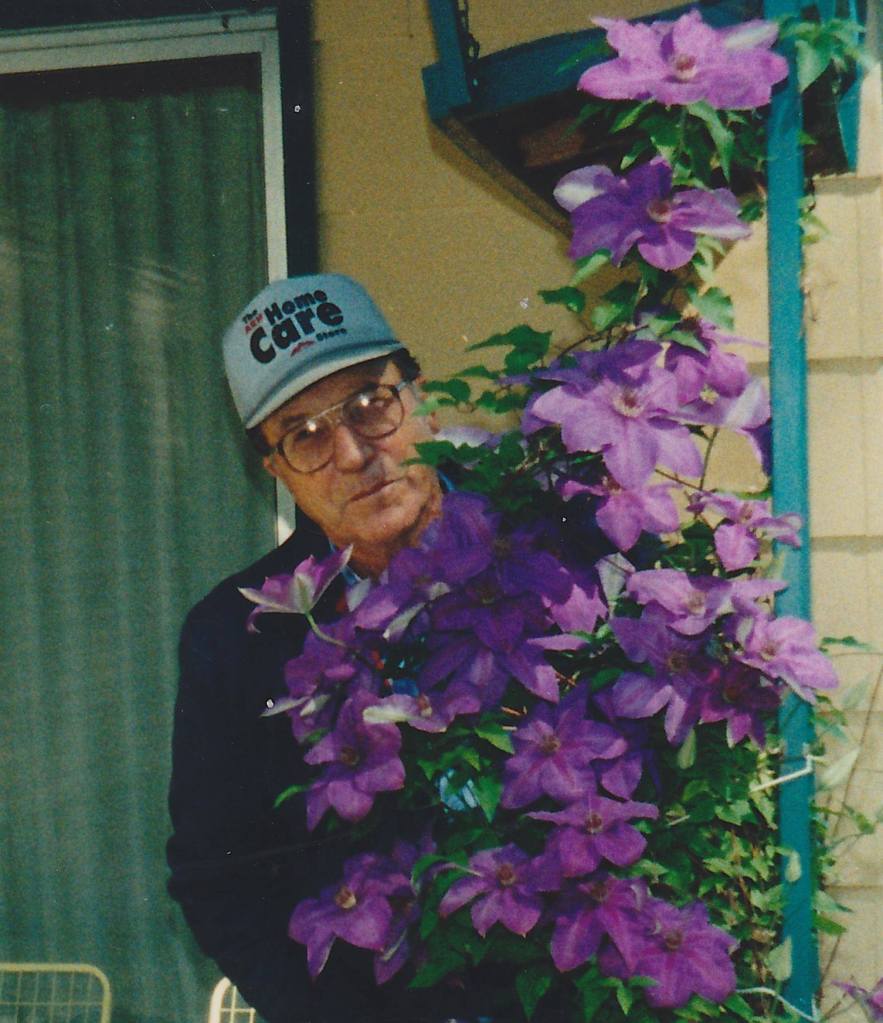
My favorite picture of Papaw, spring or summer 1997 Both as a musician and as a human, my major role model has always been my grandfather, Everett Verlin Money (1925 – 2022); I was fortunate to spend nine of his last twelve days with him, and you can hear how I processed that on albums 43 and 44, Fort Peace (just me and Julian) and So Long (me, Julian, and Tabitha).

Atop the ramparts of the original Fort Peace, July 2019 On my way back to Hawesville I grabbed a book I’d seen a million times but never read. This was Backfire (1982), by Loren Baritz, which tells the story of how the Vietnam War was lost because of bureaucratic incompetence, then goes on to predict that the same weakness is going to cost Americans the whole ballgame (specifically, our education system, which I’d spent a decade watching crumble). This got me thinking; soon after, Julian and I had cranked out #45, You Can’t Beat the System.
Part 3 of my account of our long journey as recording artists must end with Questions are Better than Answers (again featuring me, Julian, and Tabitha), as it’s our most recent record. I can’t write Part 4 yet – the future is like that, at least to our limited brains – but rest assured it’s coming. Thank you for caring. I hope Fextonia isn’t just a monument to Chad Money’s obsession with writing and recording; I hope it helps you.
-
The Sequel Is Unequal
“The Empire Strikes Back” is slightly better than “A New Hope.” The second half of my musical career has proven more meaningful than the first. “Il Buono, il Brutto, il Cattivo” (technically a prequel) is the third and best of the excellent Man with No Name trilogy. And for the love of Pike, Picard is ten times the captain Kirk was. Otherwise, you can leave sequels, remakes, and reboots alone. There’s never so much as a tie.
Now then — where were we? Right; it’s November 2009 and I’m sloshed. I’m not proud of this part of the story, so let’s just hit the highlights: I move to Louisville, make a bunch of bad decisions, and freeze my creative fount until December 2011, when I manage to crank out “The Mirror” and work on the aptly named Evil Autopilot album resumes. The worst is over – Fextonia 17 is finished and released in August 2012 – but this looks to be the last gasp of a dying band.
I got lucky. My move northwest introduced me to several new quality players who also became good friends, starting with this guy:
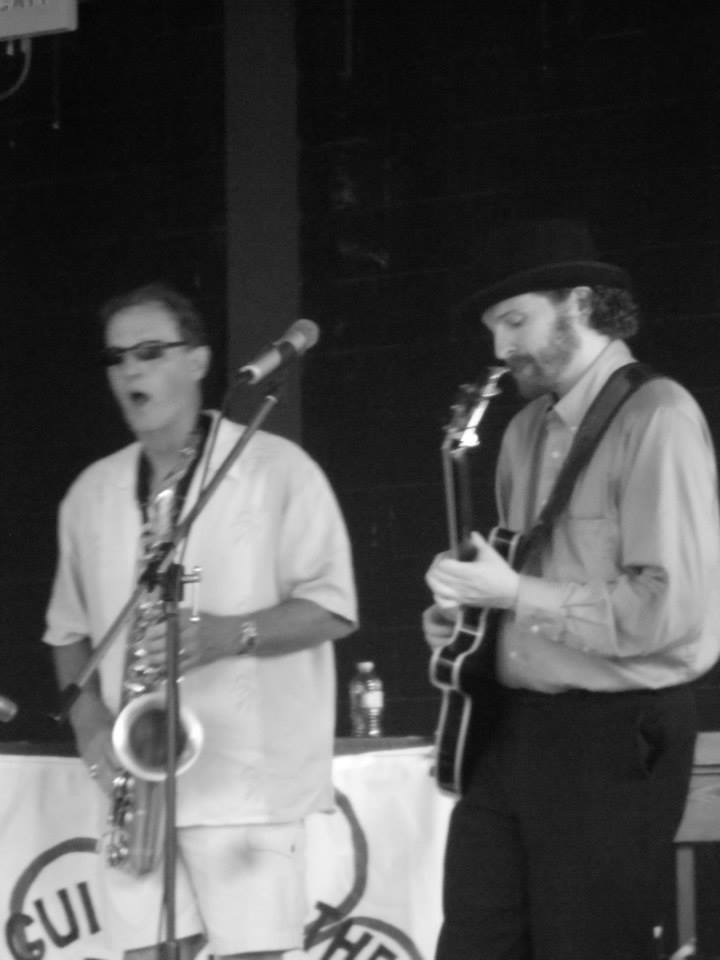
Herb and me in ’12 or ’13. Saxophonist and keyboardist Herb Shown became the core of a new, Louisville-based version of Fextonia, along with his vocalist-percussionist wife Helen. In their basement we worked up new material, rehearsed it till we were ready, and then showed it to the world.
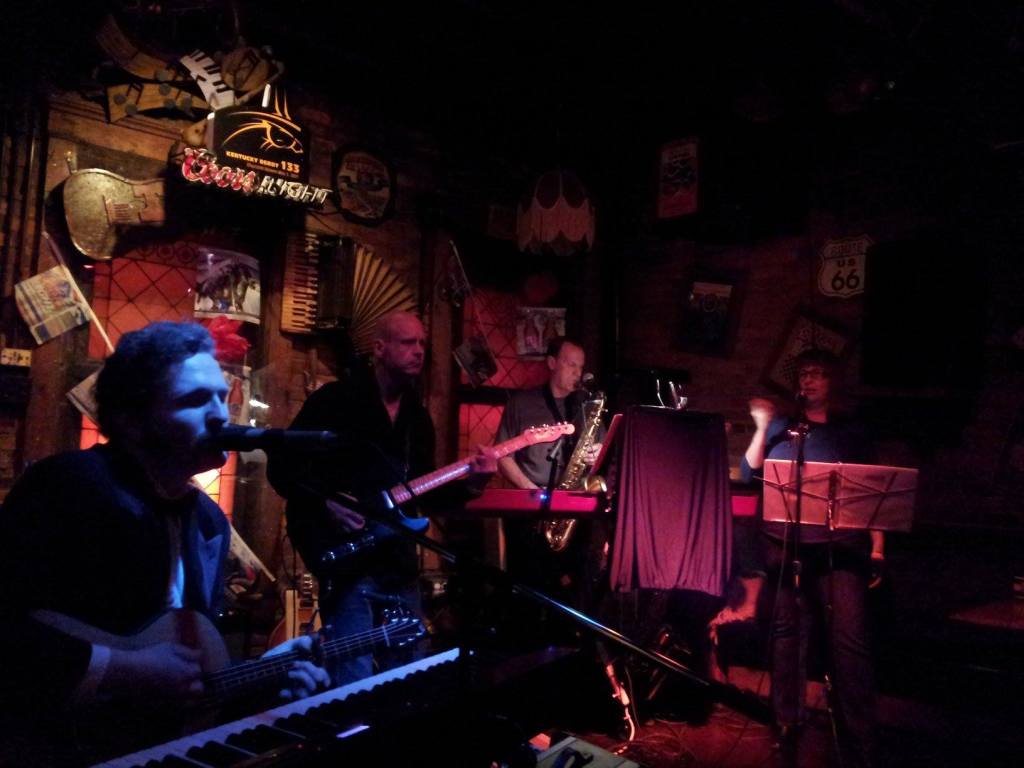
Fextonia at the venerable Phoenix Hill Tavern, April 2014. L to R: me, Dan Paul, Herb Shown, Helen Shown. Dan Paul, guitarist extraordinaire, had known Herb for years and enthusiastically participated in our eighteenth release, much as Jarrod had in our second. On Katherine’s Moment in the Sun (released in July 2014), Dan co-wrote three songs, co-produced, and handled the lion’s share of the engineering duties. Other new faces contributing to this album were bassist Dan Huber, drummer David Castello, and a certain 3-year-old we’ll formally meet shortly.
For my part, I was finally changing; I may not be perfect, but I haven’t been a drunkard since September 2014. Naturally, a series of new challenges immediately presented themselves — and (long story short) they lost.
The first half of 2015 was stormy and magical; I got my personal life in order, finished the ol’ Ph.D., and was a busy bee in the studio. Fextonia knocked out The Answer in April, with the same lineup as its predecessor (minus the Showns) and the only question left was “Now what?”
A return to the holler, that’s what! Both Brandon and Dave (recently back from Canada) suggested a reunion album, which Jarrod and I thought was peachy keen. During the course of several visits to my home county, we had a lot of fun making Twenty Years (with help from bassist/lyricist Gary Lee and a certain 4-year-old we’ll formally meet shortly). It was released in late December, 19 years after we got started, so sue us for false advertising.
Album 21 was a hybrid affair; Jarrod and Brandon (virtually) joined forces with Dan Paul and Louisville keyboardist Tess Moloney for May 2016’s Halfway There. This collection marks the real musical debut of my son Julian, who went from “that cute kid who claps along” to co-writing three tracks and playing additional keyboards, at the tender age of 5. Have I pushed him? Nope. But I’ve given him opportunities, and he’s delighted in seizing them.
For our next trick we reconvened in Bell County, “we” meaning myself, Jarrod, Brandon, Dave, Julian, and – yay! – Uncle Dale. Whence the Piper Pipes was done by early September. Now back up to Louisville for another hybrid lineup: January 2017’s Greatest Hits (actually just another studio album; we’re so clever!) featured Jarrod, Brandon, Julian, Herb, Jamie Haley, and Dan Huber (whose composition “You Were Made for Me,” written in 1980 but never recorded, holds the honor of being, in its way, the oldest Fextonia song).
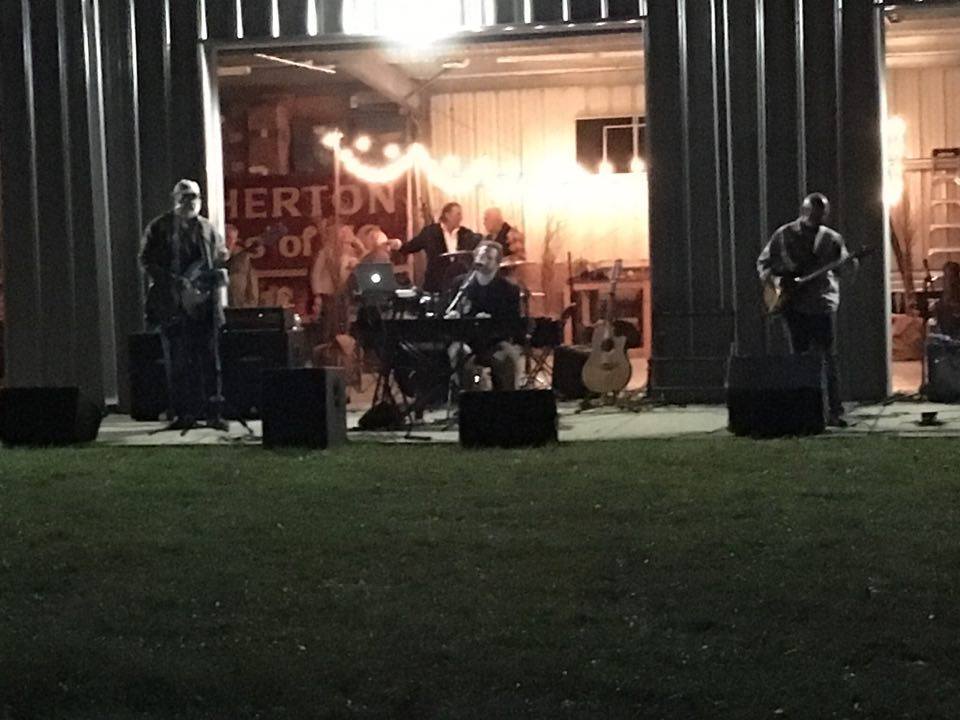
Fextonia at Farmcastle Music Festival, October 2016. L to R: Dan Huber, people backstage, me, Dan Paul. This sort of back-and-forth is not normal for a working band, but I was getting the hang of it. Our 24th album, Interesting Times, ranks as perhaps our most overtly political (if you’re into that sort of thing) and certainly one of our strongest — and it involved a stripped-down lineup of me, Dave, Julian, and Uncle Dale. Upon its release in late May 2017, we rested on our laurels for a much-needed break.
Just kidding; Julian and I worked with Dan Paul and three newcomers – guitarist Bernie Sheehan, bassist Bob Hart, and drummer Paul Woods – to have the sprawling Ma, Mu, and the Great Train Robbery ready by Groundhog Day 2018. It remains the Fextonia album with the most tracks (18) and is, for the most part, pretty darn experimental. The same group (minus Bernie) fabricated the more rock-oriented River Be Still by July. One song, “Forever Kind of Love,” came about when Bob found a lyric sheet written by his late brother Jerry. The two had written many songs together, and they got to do it one last time.

The 2017-18 squad on Herb’s couch. L to R: Dan Paul, me, Paul Woods, Bob Hart. Yes, we all have drumsticks. Alas, Paul Woods took his leave after album 26; good fortune next led me to guitarist Phil Impellizzeri and drummer Pat Matheny. These two longtime allies joined Dan, Bob, and the Money boys to make two albums in 2019: Nameless Nick Can’t Stop Quitting in June and Legendary Legend in December. Remember 2019? Something has changed since then, but I can’t quite put my mask on it.
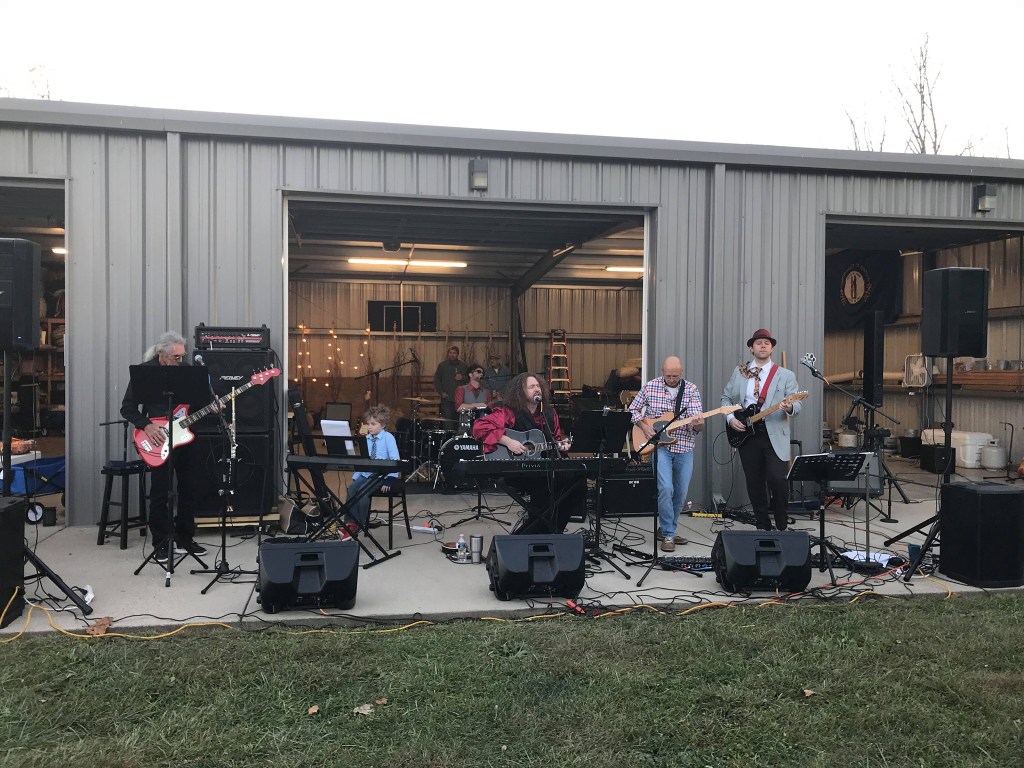
Farmcastle 2019. L to R: Bob Hart, Julian, Pat Matheny, yours truly, Dan Paul, and Phil Impellizzeri. If you dig this sort of “and then X happened” narrative, stay tuned for the third act (still in progress). It’s just beginning to get crazy.
-
Heh heh. We’re a band.
Is Halloween the only eve more famous than its successor? In any case, it all started on All Hallows’ Day 1996, when – quite on a whim – I approached my three best pals and asked “Do you want to form a band?” We were all seniors at Bell County High School in the southeast corner of Kentucky. The Internet was a novel curiosity, frizzy hair was in, and no one stared for hours into their phone. They all said “yeah, sure.” Being in a band would be fun.
As is usual, there was a spot of indecision about the group name (Sputnik’s Father and Trafalgar Circle being the best of many, many alternatives), but we ended up going with the name of a nascent nation-state in a story I’d written back in September. So it was that Fextonia – myself on guitar, Travis Smith on bass, Dave Luntsford on keyboards, and Nick Siler on drums – came to be. Needless to say, we didn’t have a clue.
In retrospect, we stumbled onto quite an unusual band-starter-kit policy: we never even thought of learning cover songs or getting gigs. I had already written seven or eight tunes, and it didn’t take long to nudge that number up to 13 and bust out an original album, March of Life. After the holidays, we got straight to work on a follow-up. This, then, was the extent of my naivety: I thought that’s how every band operated. The others surely knew better but went along with my scheme. I think it turned out to be a good call.
For my part, there was no thought of seriousness or permanence in those days. We were doing something, and we’d keep doing it until we stopped. Graduation, of course, was imminent, and we were all taking different paths come May. But I never connected that to the obvious implication. It was all very accidentally Zen.
In February 1997, two big events changed the course of things to come. First, I had a realization that this was what I wanted to do with my life. Three days later, my second cousin Jarrod Money dropped by for a visit. I’d known Jarrod since childhood but had only recently learned that he played guitar. While two years behind us in school, he was far ahead of the rest of us in skill level – already a virtuoso – and, after conferring with my mates (who said “yeah, sure”), I asked Jarrod to join our ranks. He jumped at the chance.
Nick and I had already written one song together for the second album, and Jarrod and I quickly wrote several more, making the ongoing project much more of a group effort. It wasn’t quite finished by May. After four of us removed our caps and gowns, Nick and Travis took their leave and soon moved to different states. Dave, happily, decided to stay on. We decided to finish off The Darkness of the Light as a trio.
Dave could already play the drums, and Jarrod blew me away on the guitar. We could all split up the keyboard duties, but none of us were proficient on the bass. So I volunteered to take it up and am glad I did; bass remains my favorite instrument to play both in the studio and (especially) live. Our second album, peppy and bittersweet, was finished by the end of June.
A show? What’s that? We did as much as we could toward Album #3 before I mucked things up by moving to Lexington (two hours away if I-75 isn’t clogged, which it always is) to commence higher education. Almost every weekend, I was back in Middlesborough working with the guys.
College life expanded my narrow little mind (it tends to do that), and by October I had realized that our recording equipment was absolutely terrible. We were writing good songs and playing them well, but ping-ponging tracks on a dual cassette player was burying our efforts in mud. We moved our studio into my grandfather’s garage; he was a technical wizard and rigged up such luxuries as a microphone stand (made from an infantry minesweeper!) and sound-absorbing surfaces. But without a multitrack mixing console, we would never make records the way Nature (by way of Les Paul) intended.
It was around this time that Dave got us our first real gig, in the parking lot of the local Kroger, set for the coming spring. That would end up not happening, but we didn’t know. What we did know was that we couldn’t do our stuff live as a trio, and so began the search for a fourth member. Jarrod found the right guy right away. He lived just down the road from my folks; his name was Brandon Fuson.
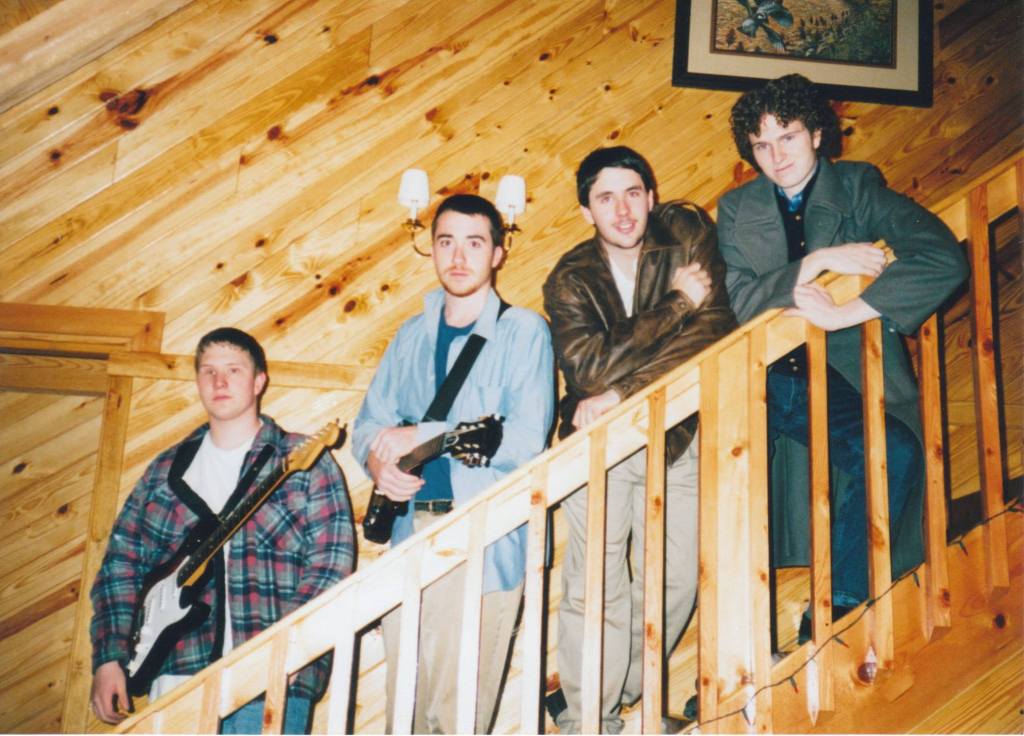
Fextonia in December 1997. Left to right: Jarrod, Brandon, Dave, et moi. Over Thanksgiving break, the four of us played together for the first time. We cobbled together a set list for the ethereal Kroger concert, but of course the album took precedence: with all four of us contributing as writers, Turning the Corner was completed in mid-December.
Now Brandon was primarily a guitarist, which led to a lot of the old switcheroo during our live set. I would play bass on the songs which didn’t require a keyboard; for those that did, I would tickle the ivories and hand the bass over to Brandon (who dutifully and quickly learned the new instrument). Role confusion is good for growth; this sort of instrument-swapping continues to be a staple of our live performances and, while logistically demanding on us, never fails to delight the audience.
The cancellation of Krogerfest ’98 was no big setback; we knocked out a fourth song collection, Paladin Road, by early summer. Jarrod took the second half of the year off to work on other things, and we had another show lined up (which also would not happen), so Brandon switched to full-time guitar and we picked up another gem: bassist Dale Partin, my uncle.
Dave was shifting into high gear as a songwriter, and between the two of us we wrote almost the entire fifth album. By this time Papaw’s renovations to his garage (generously giving up over 1/4 of his workspace for our sole use) were complete, and in early October I splurged on a four-track Tascam analog mixing console. With the release of The Electric Rose near year’s end, The Stone Age was over.
Jarrod returned to the fold in time to be a part of Album #6, which we made as a quintet: Burn Slowly hit the proverbial shelves (which, in those early days, meant someone other than a band member probably owned a copy) in June. By now Brandon was ready to branch out and explore other musical avenues; he continues to have a successful career as a solo artist, and we’ll be seeing more of him here in the Fextonia saga too.
Yet another wunderkind was waiting in the wings: Jesse Fuson, Brandon’s first cousin, eagerly stepped into the vacancy and the five of us knocked out Little Things before the end of the 1900s. Though not (in those days) as prolific a songwriter as his predecessor, Jesse at 16 already had a great ear for harmony and could wail on both guitar and mandolin; when Dale bid us adieu as the first digit of the year changed, Jesse quickly mastered the bass as well.
The Jarrod-Jesse-Chad-Dave lineup proved to be the most stable incarnation of Fextonia to date; we cranked out The King and The Tallest Building in 2000, Something About the Movies (which I still regard as one of our finest efforts) in 2001, Playing Games in 2002, and the rigorous concept album Patterns in 2003. This time it was Dave’s odyssey which shook things up — early that year, he moved all the way from Tennessee to Alberta.
(For trivia enthusiasts: 2003 was also the year we found our niche as a live act – festivals – and began to make modest tours. Thus, Fextonia is a band who made twelve studio albums before playing a single gig. Now there’s a record whose weirdness may well atone for its unimportance.)
Recruiting the estimable James Leonard to provide percussion, we made Step Forward in 2004, at which point Jesse moved on to other pursuits. Uncle Dale came back to help on Wall of Fire in 2005, but then both he and James bid farewell. For the first time, Fextonia was down to a duo.
Having purchased a 16-track Korg digital mixer, then spent a fun year learning how to use it, I busied myself rerecording all of our tape-hissy lo-fi collections in a cleaner format, enlisting historically appropriate personnel when possible. Concurrently we created 2006’s Bell County Girls with our new rhythm section: bassist Joe Bean and drummer Adam Fuson (no relation to Brandon or Jesse, so far as I know), both of whom contributed to the writing as well.
Alack, we had to find a new new rhythm section for our sixteenth minor label release. Fortunately, good musicians who are also good people keep coming our way; we joined forces with bassist Jamie Haley and drummer George “Skully” Maggard for Time Stood Still, completed in November 2008. The title is a bit of a meta-descriptor, as 2007 became the first year Fextonia both existed and did not finish an album. Partly this was because of my ongoing restoration of our first eleven long-players (a task at last completed in May 2008), but there’s a drunker reason: I had been guzzling bourbon for several years and the effects were beginning to show. I can describe this entire story in two words — enduring and unstable.

Myself and Jarrod during our show at the ruins of Harmony Elementary, 5 September 2009. Our 2009 tour was our most ambitious and satisfactory yet. One show was captured on disc and remains available, as Live at Harmony, upon request. We also recorded half of our seventeenth album. Then everything stopped. Thus concludes my youth.
Tune in next time for Part 2, which begins with a binge and goes out with a virus.
-
Mind Your Language
I have a strong command of the English language. I speak and read pretty good German, passable French, and basic Greek. I have dabbled in seven or eight other languages, from Mandarin to Klingon, and then of course there’s mathematics. So it cannot be truthfully said that, when I call for radical reform of my native tongue, I do so from a position of ignorance.
We are limited, tremendously, by the language we learn as children. Our ability to form ideas is, in large part, bounded by our knowledge of vocabulary and (less obviously) grammar, especially syntax. This is a difficult and convoluted notion, so today I’m going to point out that it exists, urge that you spend a few minutes thinking it over, and move on to something simpler: spelling.
As I see it, there is absolutely no reason not to have a one-to-one correspondence between letters and sounds. Some languages (Bosnian comes to mind) are very nearly phonetic, while others (English and especially French) flirt with chaos. The primary reason for this seems to be that the spoken language tends to evolve faster than the written one, and some orthographies have fallen way behind.
We can fix this! Let’s start with the vowels. Five letters, ten main vowel sounds. Hmm. Why not just use lowercase vowels for the “short” sounds and uppercase for the “long” sounds? There are a few other vowel sounds, such as the “oo” in “book,” but that’s nothing an accent mark couldn’t handle.
We have too many consonants. Do we really need the letter C, for instance, when we have K and S? Speaking of K and S, smush ’em together and you no longer need X (as for xenophobic xylophones, Z needs more to do anyway). And don’t even get me started on W.
Sometimes, though, we have the opposite problem. Think about the combinations TH and GH. Don’t they have enough to do? Why not put some other pairings to work on the excess workload?
No need to standardize the English language once and for all; it’ll keep evolving, as it must. But a little maintenance along the way might be just what we need. Otherwise, with text-based communication becoming so prevalent, written and spoken English may well diverge entirely. How do you pronounce the smiley face again?
-
Math and Mental Health
For some reason very few adults reminisce about the horrors of their high school French class, or sixth-grade earth science, or English 101. No, the laurels in this oddly specific contest surely rest with mathematics. I was a practicing mathematician for 10 years and knew better than to say so at a party, because here would come “Ohmygod Ihad THEWORST math teacher” or, even more self-centered and buzzkilling, “I hate math” / “math is evil.”
No it isn’t. And you don’t hate math because you don’t know what it is (neither did I until grad school). But why is this phobia so rampant, and why should anyone care?
First of all, having been a private tutor in all manner of subjects, I’m going to brazenly claim that math is easier to teach than, say, English or history or art. Yes, easier. It is also easier to learn, at least until one reaches the upper strata (500-level and above). The reason – and I find it a compelling one once you learn the knack – is that, with the singular exception of probability theory, it’s almost impossible to be confident that you’re right and still be wrong.
Yes, I know that the words “and Mental Health” are in the title. We’re getting there.
The key word is “confident.” Unfortunately, mathematics is almost always taught wrong (at least in the U.S.) and learned wrong, from elementary school all the way up to about Calc II. You see, while math is easier to teach, there aren’t many well-trained math teachers working in primary and secondary education (we’re working on that). As a result, the common misperception is that all of math goes something like this: “Here’s a very specific pointless task, and here’s how you do it.” Anybody would hate that!
Below is an example of a well-written solution to a problem from Chapter 4 of a first-semester calculus course:
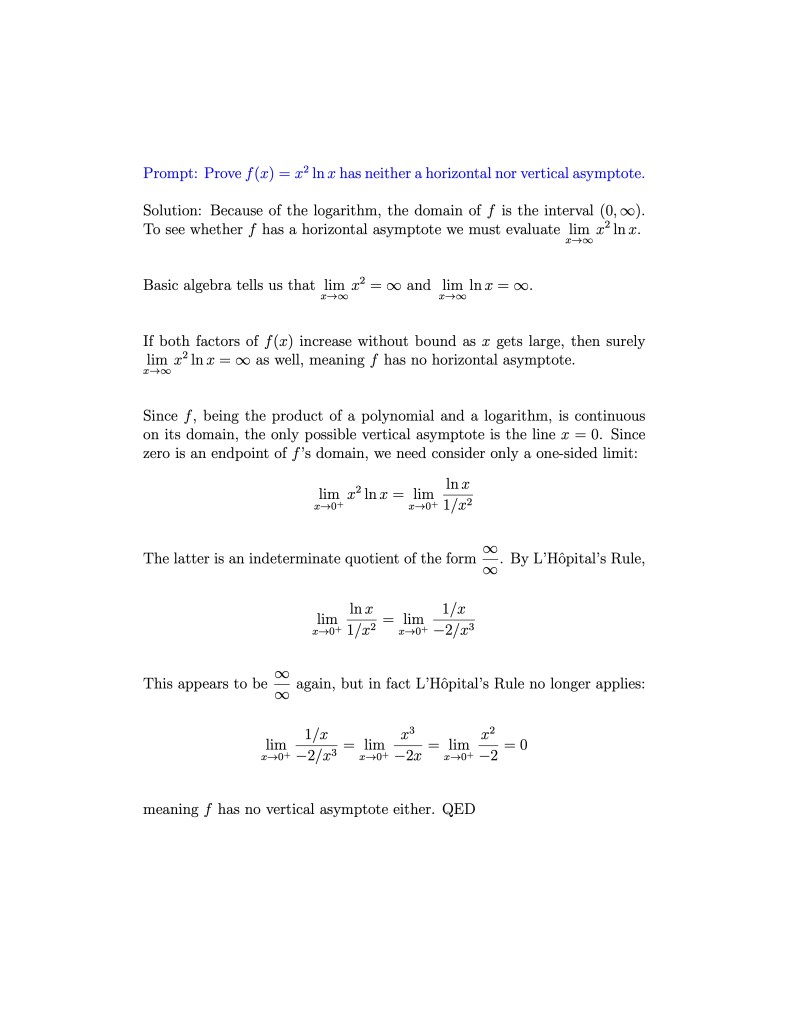
Even if you have no idea what all the mathese means, I bet you can infer a certain narrative quality in the writing. And note the prompt: we are given The Answer, that elusive snipe so often the target of befuddled young learners, and asked instead to prove the truth or falsity of a statement. This alone is a big improvement: either f(x) has an asymptote or not. So which is it and, instead of how, why?
It’s not often that you’re out in the woods and need to prove a particular function has no asymptotes. And of course one could easily get the graph of x2 ln x from one’s favorite expensive distractive device, so what’s the point?
Have you ever gone for a walk? What’s the point, when you could have moved faster and with less effort in a car? Have you ever read a work of fiction? What’s the point, when Roger Chillingworth will never come up in “real life”?
As so often in “real life,” the point is not to accomplish one particular task but rather to train your brain to think more powerfully and efficiently, preparing you for unknown future crises. There is no shortcut to this, the real objective of all quality education (academic and otherwise). To build muscle mass, you must exercise. To flawlessly play the two beautiful guitar solos in “Comfortably Numb,” you must exercise. To get smarter, you must exercise.
And you know what? 85% of the time you try to exercise the logical, mathematical part of your brain, you’re going to be WRONG. Your ideas will stink. With experience and a heck of a lot of practice, you might be able to get that down to 70%. Because of early childhood trauma (ah, there we go!), many people have a real issue with being WRONG. So maybe that’s why math is scary?
Nope. See, you’re going to be WRONG 85% of the time you have any idea at all. It’s just that other fields of thought do not come equipped with a ready-made way of demonstrating whether your idea stinks or not. Math does, and as I said earlier, that’s precisely why it’s easier to teach and learn.
Anyone who is studying first-semester calculus is capable of writing a solution as good as or better than mine. Too often, though, the prompt is phrased “Find all asymptotes of this function” and we’re back to placing emphasis on The Answer, on the how-to-pull-off-some-specific-pointless-task. The question is the same either way, isn’t it? Certainly the reasoning necessary to address the question doesn’t change. But over years of teaching, I consistently got better results when I gave away the ending and asked for the middle.
This kind of confidence is not restricted to mathematics, although it’s easiest to apply it there. “Be sure you’re right, then go ahead” is sage advice. And in the process of being sure, you will almost surely have to be WRONG a few dozen times. That’s real life. Embrace it.
-
Subscribe
Subscribed
Already have a WordPress.com account? Log in now.
 The Fextonia Saga