Is Halloween the only eve more famous than its successor? In any case, it all started on All Hallows’ Day 1996, when – quite on a whim – I approached my three best pals and asked “Do you want to form a band?” We were all seniors at Bell County High School in the southeast corner of Kentucky. The Internet was a novel curiosity, frizzy hair was in, and no one stared for hours into their phone. They all said “yeah, sure.” Being in a band would be fun.
As is usual, there was a spot of indecision about the group name (Sputnik’s Father and Trafalgar Circle being the best of many, many alternatives), but we ended up going with the name of a nascent nation-state in a story I’d written back in September. So it was that Fextonia – myself on guitar, Travis Smith on bass, Dave Luntsford on keyboards, and Nick Siler on drums – came to be. Needless to say, we didn’t have a clue.
In retrospect, we stumbled onto quite an unusual band-starter-kit policy: we never even thought of learning cover songs or getting gigs. I had already written seven or eight tunes, and it didn’t take long to nudge that number up to 13 and bust out an original album, March of Life. After the holidays, we got straight to work on a follow-up. This, then, was the extent of my naivety: I thought that’s how every band operated. The others surely knew better but went along with my scheme. I think it turned out to be a good call.
For my part, there was no thought of seriousness or permanence in those days. We were doing something, and we’d keep doing it until we stopped. Graduation, of course, was imminent, and we were all taking different paths come May. But I never connected that to the obvious implication. It was all very accidentally Zen.
In February 1997, two big events changed the course of things to come. First, I had a realization that this was what I wanted to do with my life. Three days later, my second cousin Jarrod Money dropped by for a visit. I’d known Jarrod since childhood but had only recently learned that he played guitar. While two years behind us in school, he was far ahead of the rest of us in skill level – already a virtuoso – and, after conferring with my mates (who said “yeah, sure”), I asked Jarrod to join our ranks. He jumped at the chance.
Nick and I had already written one song together for the second album, and Jarrod and I quickly wrote several more, making the ongoing project much more of a group effort. It wasn’t quite finished by May. After four of us removed our caps and gowns, Nick and Travis took their leave and soon moved to different states. Dave, happily, decided to stay on. We decided to finish off The Darkness of the Light as a trio.
Dave could already play the drums, and Jarrod blew me away on the guitar. We could all split up the keyboard duties, but none of us were proficient on the bass. So I volunteered to take it up and am glad I did; bass remains my favorite instrument to play both in the studio and (especially) live. Our second album, peppy and bittersweet, was finished by the end of June.
A show? What’s that? We did as much as we could toward Album #3 before I mucked things up by moving to Lexington (two hours away if I-75 isn’t clogged, which it always is) to commence higher education. Almost every weekend, I was back in Middlesborough working with the guys.
College life expanded my narrow little mind (it tends to do that), and by October I had realized that our recording equipment was absolutely terrible. We were writing good songs and playing them well, but ping-ponging tracks on a dual cassette player was burying our efforts in mud. We moved our studio into my grandfather’s garage; he was a technical wizard and rigged up such luxuries as a microphone stand (made from an infantry minesweeper!) and sound-absorbing surfaces. But without a multitrack mixing console, we would never make records the way Nature (by way of Les Paul) intended.
It was around this time that Dave got us our first real gig, in the parking lot of the local Kroger, set for the coming spring. That would end up not happening, but we didn’t know. What we did know was that we couldn’t do our stuff live as a trio, and so began the search for a fourth member. Jarrod found the right guy right away. He lived just down the road from my folks; his name was Brandon Fuson.
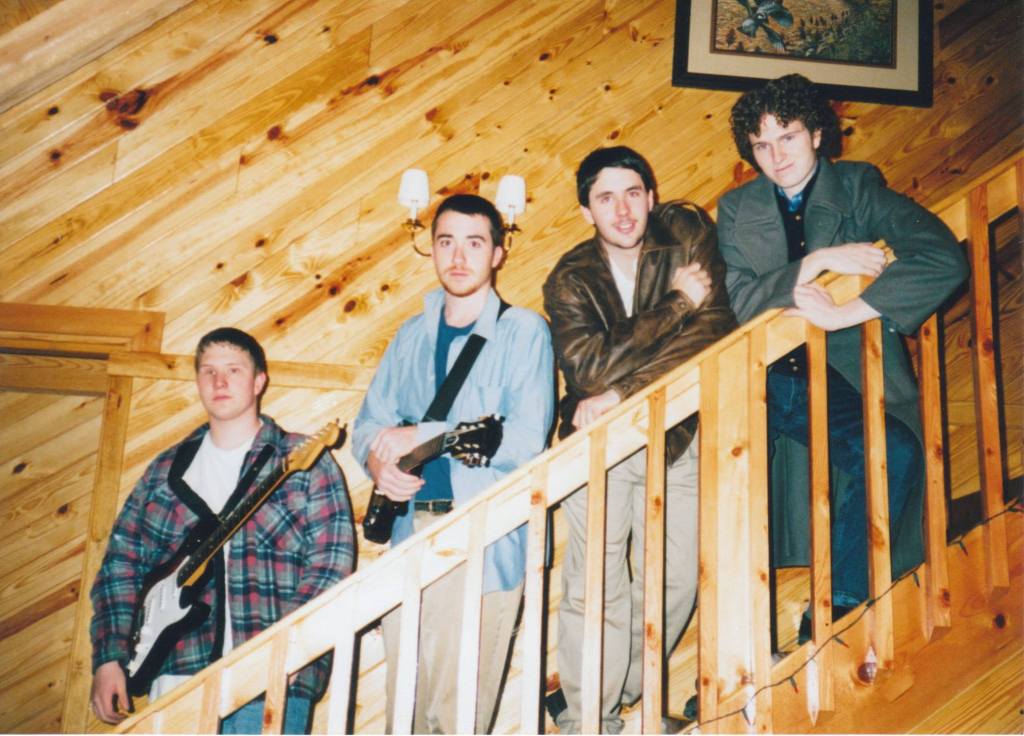
Over Thanksgiving break, the four of us played together for the first time. We cobbled together a set list for the ethereal Kroger concert, but of course the album took precedence: with all four of us contributing as writers, Turning the Corner was completed in mid-December.
Now Brandon was primarily a guitarist, which led to a lot of the old switcheroo during our live set. I would play bass on the songs which didn’t require a keyboard; for those that did, I would tickle the ivories and hand the bass over to Brandon (who dutifully and quickly learned the new instrument). Role confusion is good for growth; this sort of instrument-swapping continues to be a staple of our live performances and, while logistically demanding on us, never fails to delight the audience.
The cancellation of Krogerfest ’98 was no big setback; we knocked out a fourth song collection, Paladin Road, by early summer. Jarrod took the second half of the year off to work on other things, and we had another show lined up (which also would not happen), so Brandon switched to full-time guitar and we picked up another gem: bassist Dale Partin, my uncle.
Dave was shifting into high gear as a songwriter, and between the two of us we wrote almost the entire fifth album. By this time Papaw’s renovations to his garage (generously giving up over 1/4 of his workspace for our sole use) were complete, and in early October I splurged on a four-track Tascam analog mixing console. With the release of The Electric Rose near year’s end, The Stone Age was over.
Jarrod returned to the fold in time to be a part of Album #6, which we made as a quintet: Burn Slowly hit the proverbial shelves (which, in those early days, meant someone other than a band member probably owned a copy) in June. By now Brandon was ready to branch out and explore other musical avenues; he continues to have a successful career as a solo artist, and we’ll be seeing more of him here in the Fextonia saga too.
Yet another wunderkind was waiting in the wings: Jesse Fuson, Brandon’s first cousin, eagerly stepped into the vacancy and the five of us knocked out Little Things before the end of the 1900s. Though not (in those days) as prolific a songwriter as his predecessor, Jesse at 16 already had a great ear for harmony and could wail on both guitar and mandolin; when Dale bid us adieu as the first digit of the year changed, Jesse quickly mastered the bass as well.
The Jarrod-Jesse-Chad-Dave lineup proved to be the most stable incarnation of Fextonia to date; we cranked out The King and The Tallest Building in 2000, Something About the Movies (which I still regard as one of our finest efforts) in 2001, Playing Games in 2002, and the rigorous concept album Patterns in 2003. This time it was Dave’s odyssey which shook things up — early that year, he moved all the way from Tennessee to Alberta.
(For trivia enthusiasts: 2003 was also the year we found our niche as a live act – festivals – and began to make modest tours. Thus, Fextonia is a band who made twelve studio albums before playing a single gig. Now there’s a record whose weirdness may well atone for its unimportance.)
Recruiting the estimable James Leonard to provide percussion, we made Step Forward in 2004, at which point Jesse moved on to other pursuits. Uncle Dale came back to help on Wall of Fire in 2005, but then both he and James bid farewell. For the first time, Fextonia was down to a duo.
Having purchased a 16-track Korg digital mixer, then spent a fun year learning how to use it, I busied myself rerecording all of our tape-hissy lo-fi collections in a cleaner format, enlisting historically appropriate personnel when possible. Concurrently we created 2006’s Bell County Girls with our new rhythm section: bassist Joe Bean and drummer Adam Fuson (no relation to Brandon or Jesse, so far as I know), both of whom contributed to the writing as well.
Alack, we had to find a new new rhythm section for our sixteenth minor label release. Fortunately, good musicians who are also good people keep coming our way; we joined forces with bassist Jamie Haley and drummer George “Skully” Maggard for Time Stood Still, completed in November 2008. The title is a bit of a meta-descriptor, as 2007 became the first year Fextonia both existed and did not finish an album. Partly this was because of my ongoing restoration of our first eleven long-players (a task at last completed in May 2008), but there’s a drunker reason: I had been guzzling bourbon for several years and the effects were beginning to show. I can describe this entire story in two words — enduring and unstable.

Our 2009 tour was our most ambitious and satisfactory yet. One show was captured on disc and remains available, as Live at Harmony, upon request. We also recorded half of our seventeenth album. Then everything stopped. Thus concludes my youth.
Tune in next time for Part 2, which begins with a binge and goes out with a virus.
 The Fextonia Saga