For some reason very few adults reminisce about the horrors of their high school French class, or sixth-grade earth science, or English 101. No, the laurels in this oddly specific contest surely rest with mathematics. I was a practicing mathematician for 10 years and knew better than to say so at a party, because here would come “Ohmygod Ihad THEWORST math teacher” or, even more self-centered and buzzkilling, “I hate math” / “math is evil.”
No it isn’t. And you don’t hate math because you don’t know what it is (neither did I until grad school). But why is this phobia so rampant, and why should anyone care?
First of all, having been a private tutor in all manner of subjects, I’m going to brazenly claim that math is easier to teach than, say, English or history or art. Yes, easier. It is also easier to learn, at least until one reaches the upper strata (500-level and above). The reason – and I find it a compelling one once you learn the knack – is that, with the singular exception of probability theory, it’s almost impossible to be confident that you’re right and still be wrong.
Yes, I know that the words “and Mental Health” are in the title. We’re getting there.
The key word is “confident.” Unfortunately, mathematics is almost always taught wrong (at least in the U.S.) and learned wrong, from elementary school all the way up to about Calc II. You see, while math is easier to teach, there aren’t many well-trained math teachers working in primary and secondary education (we’re working on that). As a result, the common misperception is that all of math goes something like this: “Here’s a very specific pointless task, and here’s how you do it.” Anybody would hate that!
Below is an example of a well-written solution to a problem from Chapter 4 of a first-semester calculus course:
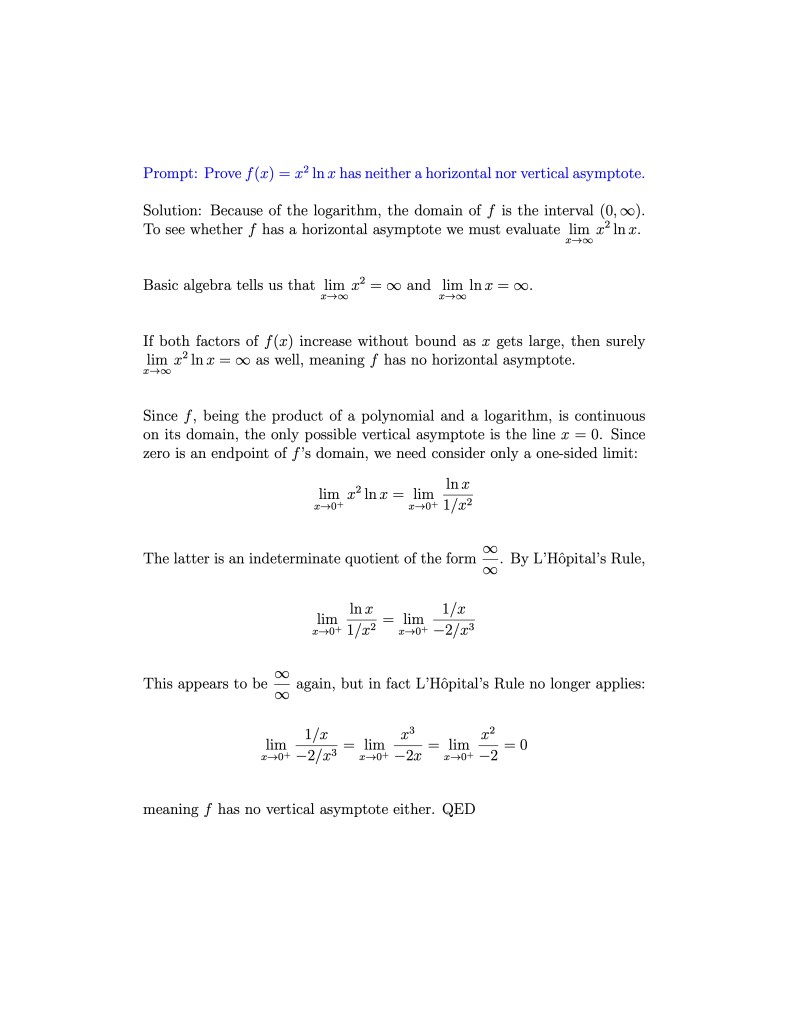
Even if you have no idea what all the mathese means, I bet you can infer a certain narrative quality in the writing. And note the prompt: we are given The Answer, that elusive snipe so often the target of befuddled young learners, and asked instead to prove the truth or falsity of a statement. This alone is a big improvement: either f(x) has an asymptote or not. So which is it and, instead of how, why?
It’s not often that you’re out in the woods and need to prove a particular function has no asymptotes. And of course one could easily get the graph of x2 ln x from one’s favorite expensive distractive device, so what’s the point?
Have you ever gone for a walk? What’s the point, when you could have moved faster and with less effort in a car? Have you ever read a work of fiction? What’s the point, when Roger Chillingworth will never come up in “real life”?
As so often in “real life,” the point is not to accomplish one particular task but rather to train your brain to think more powerfully and efficiently, preparing you for unknown future crises. There is no shortcut to this, the real objective of all quality education (academic and otherwise). To build muscle mass, you must exercise. To flawlessly play the two beautiful guitar solos in “Comfortably Numb,” you must exercise. To get smarter, you must exercise.
And you know what? 85% of the time you try to exercise the logical, mathematical part of your brain, you’re going to be WRONG. Your ideas will stink. With experience and a heck of a lot of practice, you might be able to get that down to 70%. Because of early childhood trauma (ah, there we go!), many people have a real issue with being WRONG. So maybe that’s why math is scary?
Nope. See, you’re going to be WRONG 85% of the time you have any idea at all. It’s just that other fields of thought do not come equipped with a ready-made way of demonstrating whether your idea stinks or not. Math does, and as I said earlier, that’s precisely why it’s easier to teach and learn.
Anyone who is studying first-semester calculus is capable of writing a solution as good as or better than mine. Too often, though, the prompt is phrased “Find all asymptotes of this function” and we’re back to placing emphasis on The Answer, on the how-to-pull-off-some-specific-pointless-task. The question is the same either way, isn’t it? Certainly the reasoning necessary to address the question doesn’t change. But over years of teaching, I consistently got better results when I gave away the ending and asked for the middle.
This kind of confidence is not restricted to mathematics, although it’s easiest to apply it there. “Be sure you’re right, then go ahead” is sage advice. And in the process of being sure, you will almost surely have to be WRONG a few dozen times. That’s real life. Embrace it.
 The Fextonia Saga